
PT-141 (Bremelanotide)
What is PT-141 (Bremelanotide)?
PT-141, also known as Bremelanotide, is a synthetic peptide that activates melanocortin receptors, primarily MC3R and MC4R, in the central nervous system. It is a derivative of Melanotan II, but unlike its parent compound, PT-141 does not significantly affect skin pigmentation. Instead, it is researched and FDA-approved for its role in enhancing sexual desire and arousal, particularly in women.
Potential Benefits Shown in Studies
- Increasing sexual arousal and libido
- Improving erectile function in men
- Enhancing sexual desire in premenopausal women
- Acting on the central nervous system (not hormones)
- Offering benefits without significantly affecting blood pressure or hormones
- Working independently of testosterone or estrogen levels
Mechanisms of Action
PT-141 acts directly on the nervous system, not the vascular system, which differentiates it from drugs like Viagra or Cialis. It works by:
- Stimulating melanocortin receptors in the brain, enhancing libido
- Increasing sexual arousal by acting on MC4R (linked to arousal and motivation)
- Bypassing hormonal pathways, offering effects even in low-testosterone states
- Triggering natural physiological responses associated with sexual readiness
Research Highlights
FDA Approval for Hypoactive Sexual Desire Disorder (HSDD)
PT‑141 (marketed as Vyleesi) received FDA approval in 2019 for treating acquired, generalized HSDD in premenopausal women, offering an as-needed treatment for low desire.
Central Nervous System Mechanism via Melanocortin Receptors
Bremelanotide acts centrally by activating melanocortin receptors—chiefly MC3R and MC4R—in the brain to directly enhance sexual desire and arousal, distinct from vascular-centric treatments.
Clinical Evidence of Efficacy in Human Trials
Phase III clinical trials have demonstrated that Bremelanotide increases sexual desire scores and reduces related psychological distress compared to placebo in women with HSDD.
Neurobehavioral Impact Documented via fMRI Study
An fMRI-based, double-blind, crossover clinical study found that Bremelanotide alters brain activity—damping self-consciousness while enhancing erotic sensitivity and positive response in women with HSDD.
Molecular Structure
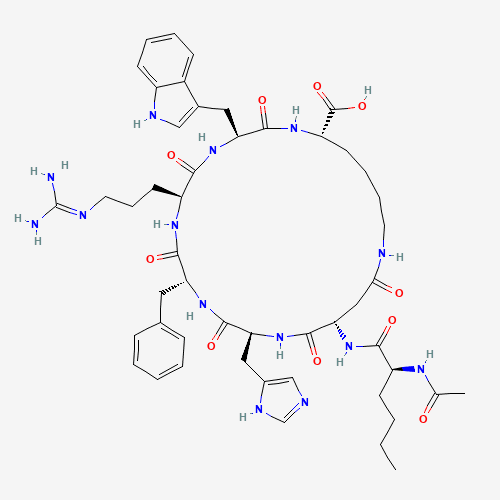
Ac-Nle-c[Asp-His-D-Phe-Arg-Trp-Lys]-OH
C₅₀H₆₈N₁₄O₁₀
1025.2 g/mol
Note: PT-141 is a cyclized heptapeptide; similar base as Melanotan II with different terminal modification